Showing posts with label Historical reference. Show all posts

Wednesday, April 14, 2010

Thailand: Series 10 Banknotes


Thailand 100 Baht banknote P79a Series 10

100 Baht banknotes of Series 9 were heavily counterfeited forcing the government to issue a new series in 1968. The 10th series comprised of only one denomination i.e. 100 Baht. To prevent counterfeiting, these banknotes printed at Thomas de la Rue, used intaglio printing and security threads with microlettering ประเทศไทย (or as Thailand is written in Thai) printed at intervals. These notes were used for another 4 years before Series 11 was introduced in 1972.

Thailand 100 Baht P79a Series 10 banknote detail

As stated above and in checklist below, only 100 Baht denomination with 2 signature varieties are available for this banknote. These notes are very popular items for Thai banknote collectors and cost about 1,000 Baht for a pair (UNC - both sig varieties).


Thailand 100 Baht banknote P79a Series 10 checklist
Click on above image to see Checklist of Series 10 banknotes. For MS-Excel or PDF checklists, please contact me at sbasu@loxinfo.co.th

Sunday, April 11, 2010

Thailand: Series 9 Banknotes


Series 8 banknotes were the last banknotes issued with HM King Rama 8's portrait as he passed away on 9 June 1946. Series 9 banknotes issued from 1948 onwards carried portrait of HM King Bhumibol Adulyadej (Rama 9). This series, printed by Thomas de la Rue, were used for almost 20 years and forms the basis for design (colour) of present day banknotes in circulation.

Thailand Series 9 banknote Baht
Series 9 banknotes
Images courtesy www.siambanknote.com


Denominations issued were 50 Satang, 1 Baht, 5 Baht, 10 Baht, 20 Baht and 100 Baht. 1,000 Baht notes were printed but never issued into circulation fearing inflation.

50 Satang notes issued in 1948 were of only 1 type while 1-20 Baht notes had 6 different design types and 100 Baht had 5 types. The type varieties as given in Checklist and images below differ mainly in:

a) Portrait type - Younger King's portrait and King in Field Marshal's uniform
b) Serial number colour - Red and Black
c) Security thread - Scattered Red and Blue threads and Metal Security thread
d) Watermark - Constitution on pedestal tray and King's portrait
e) 2-line text on reverse - Small and Large font and also wording

Thailand Series 9 banknote type Thailand Series 9 banknote type Thailand Series 9 banknote type
Click on above images to see type variety details

Thailand Series 9 50 Satang banknote checklist
50 Satang Checklist

Thailand Series 9 1 Baht banknote checklist
1 Baht Checklist

Thailand Series 9 5 Baht banknote checklist
5 Baht Checklist

Thailand Series 9 10 Baht banknote checklist
10 Baht Checklist

Thailand Series 9 20 Baht banknote checklist
20 Baht Checklist

Thailand Series 9 100 Baht banknote checklist
100 Baht Checklist

Thailand Series 9 1000 Baht banknote checklist
1,000 Baht Checklist

Click on above images to see Checklists of Series 9 banknotes. For MS-Excel or PDF checklists, please contact me at sbasu@loxinfo.co.th

Tuesday, March 16, 2010

Thailand: Siam Anachak Coins of Rama 5


The decimal system devised by HRH Prince Mahisorn, in which 1 Baht = 100 Satang, was introduced by HM King Rama 5 in 1897. The first coins made of cupro-nickel and dated 1897 were issued in 1898. Denominations issued were 2½, 5, 10 and 20 Satang. These coins are known as the "Siam Anachak" (สยามอาณาจักร) coins. These coins were also the first coins carrying the three-headed elephant. Note that date on the coins is ศก ๑๑๖ which is same as ร.ศ. (RS). RS 116 is equivalent to 1897.


Click to see Checklist of Siam Anachak coins.

Please refer to my previous posts Thailand: Circulating coin denominations and Thailand: Coin Dating to understand denominations and dates.

Sunday, March 14, 2010

Thailand: Portrait-Phra Siam Thevathiraj Coins of Rama 5


Thailand is the only country in this region which has never been colonised in its history. When all its neighbours were been colonised either by the British or the French, Siam ( as Thailand was known) remained an independent Kingdom thanks to various treaties signed with the colonial powers. HM King Rama 5 thought that there must be a holy deity which is protecting the country and should be sculpted and worshipped. An 8" statue of Phra Siam Thevathiraj (or City God) made of solid gold was sculpted on his orders and is worshipped till today.


Phra Siam Thevathiraj statue


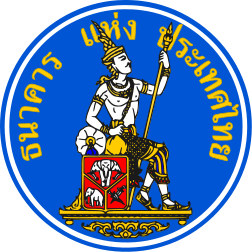
Phra Siam Thevathiraj Bank of Thailand seal
Bank of Thailand seal depicting Phra Siam Thevathiraj


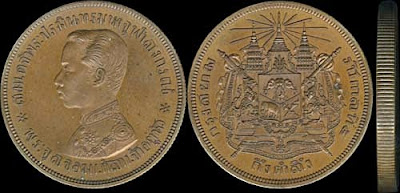
This series of coins, known as the Portrait - Phra Siam Thevathiraj coins (เหรียญทองแดง พระบรมรูป - พระสยามเทวาธิราช ) carries HM King Rama 5's portrait on obverse and Phra Siam Thevathiraj with denomination and date on reverse.


Denominations issued were 1 Solot, 1 Att and 1 Sio. Only the first year carried the C.S. date (CS1249 or 1887). Then onwards the coins carried RS dates. Die rotation varieties exist for all three denominations as given in the checklist. The 1 Att coin for years RS 114 and 122 have different die rotation and date numeral size combination.


^^ or medallion die rotation coins have large numerals while ^v (standard die rotation) have small numerals


Checklist Rama 5 Phra Siam Thevathiraj coins

Click to see Checklist of Portrait - Phra Siam Thevathiraj coins.

Please refer to my previous posts Thailand: Circulating coin denominations and Thailand: Coin Dating to understand denominations and dates.

Saturday, March 13, 2010

Thailand: Portrait-Coat of Arms Coins of Rama 5


The first coins to carry the portrait of HM King Rama 5 were issued in 1876. These coins were minted using the latest steam powered press bought from Taylor and Challen in 1875 and carried the coat of arms, designed by Rama 5 in 1873, on reverse. This series of coins, therefore, are known as the Portrait - Coat of Arms (พระบรมรูป - ตราแผ่นดิน).

Siam Coat of Arms Rama 5
Rama 5 silver Coat of Arms Y32-34
Silver Portrait - Coat of Arms coins


Denominations issued were 1 Fuang, 1 Salueng and 1 Baht. From 1876 to 1900 the coins did not carry dates. From 1901 onwards all coins of this series carried RS dates.

1 Baht Coat of Arms 1 Salueng Coat of Arms 1 Fuang Coat of Arms

Gold 1 Fuang coins were also issued with portrait on obverse and Coat of Arms on reverse. 1 Salueng gold coin is reported to exist but are extremely rare.

Gold Fuang Coat of Arms Rama 5 coins
Other rare coins in this series are the patterns. A copper pattern for 1 KuengTamlung (2 Baht) is up for auction at Eurseree on 28th March 2010 with a starting price of 600,000 Baht or USD 18,200.

Pn36 Tin Pattern Coat of ARms

Please refer to my previous posts Thailand: Circulating coin denominations and Thailand: Coin Dating to understand denominations and dates.


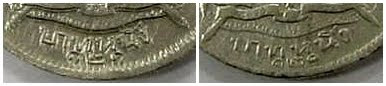
Y# 34a 1 Baht RS 121 date variety
Date varieties of 1 Baht RS 121


Click to see Checklist of Portrait - Coat of Arms coins.


All coin images courtesy www.eurseree.com

Tuesday, March 9, 2010

Thailand: Monogram-Wreath Coins of Rama 5


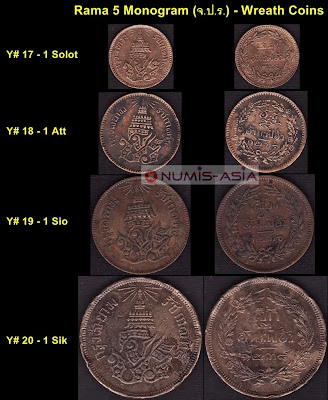
Second series of coins issued during the reign of HM King Rama 5 are known as the Monogram - Wreath (จ.ป.ร. - ช่อชัยพฤกษ์) coins as the obverse carries the royal monogram จ.ป.ร. (pronounced as Cho Po Ro) while the reverse consists of the denomination and year within a wreath.

Denominations issued were 1 Solot (1/2 Att), 1 Att, 1 Sio (2 Att) and 1 Sik (4 Att). All denominations are copper coins. 1 Att coins made of Nickel are reported to exist but are very very rare. Refer to my previous post Thailand: Circulating coin denominations to understand the denominations.

Note that these are also the first coins where C.S. or จ.ศ.(Chula Sakarat จุลศักราช) dates appeared. See Thailand: Coin Dating.
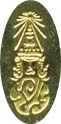
Rama 5 monogram จ.ป.ร.
จ.ป.ร. monogram


 Rama 5 Monogram Wreath coins จ.ป.ร. - ช่อชัยพฤกษ์


Click to see Checklist of Monogram-Wreath coins.

Friday, March 5, 2010

Thailand: Chula Mongkut-Chakra coins of Rama 5


HM King Rama 5 became the 5th king of the Chakri dynasty in 1868. The first coins minted during his reign were the 1 Solot tin coins. Issued in 1868 (B.E. 2411) the coins had three crowns or Chula Mongkut (privy seal of HM King Rama 5) on obverse and an Elephant within a Chakra (wheel) on reverse. Several patterns made out of Copper and Silver in the same year are known to exist.

Y# 16 - 1 Solot (1/16 Fuang or 1/128 Baht)

Chula Mongkut privy seal of HM King Rama 5


Chula Mongkut Chakra coins silver Rama 5 Chulalongkorn

In 1869 (B.E. 2412), silver coins for 1 Fuang, 1 Solot and 1 Baht were issued carrying same design as shown above.


Click to see Checklist of Chula Mongkut-Chakra coins.

Note that in Standard Catalog of World Coins 1801-1900 published by Krause Publications, these coins are stated to have been issued during reign of HM King Rama 4. This is not correct as the privy seal of HM King Rama 4 was different and as shown below.

Privy Seal HM King Rama 4 Mongkut
Maha Mongkut privy seal of HM King Rama 4


Saturday, February 27, 2010

Thailand: Coin Dating


Coins minted before 1874 AD did not carry any dates. Copper coins issued in 1874 during the reign of HM King Rama 5 were the first coins where C.S. or จ.ศ.(Chula Sakarat จุลศักราช) dates appeared. CS dating is believed to have started in Burma during 639 AD and used widely in Lanna, Sukhothai and Ayuthaya periods and in Burma and Cambodia.

Thai coins dating C.S. CS
Y# 19 - 1 Sio CS 1236 (1874AD)

In 1888 HM King Rama 5 declared 1782 as the epoch for the counting of years. This is because on April 6, 1782, Rattanakosin (present day Bangkok) was established as the capital by HM King Rama I and thus began the present Chakri dynasty.

From 1890 all coins carried R.S. or ร.ศ. (Rattanakosin Sok รัตนโกสนทรศก) dates.

Thai coin dating R.S. RS
Y# 22 1 Att RS 122 (1903AD)

In 1912 HM King Rama 6 changed the year counting to B.E. or พ.ศ. (Budhist Era พุทธศักราช). Coins since then carry on B.E. dates.

Thai coins dating B.E. BE
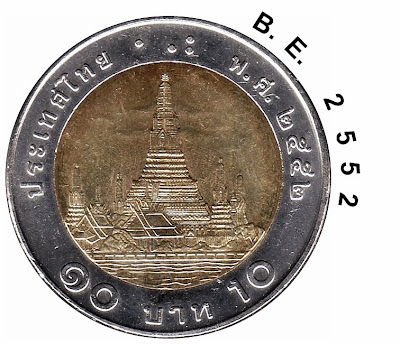
New series 10 Baht circulation coin BE 2552 (2009AD)

Date conversion table below will help converting dates from different calendar eras.

Thai numerals

Thai coin date calculation B.E. A.D. C.S. R.S.

Thursday, February 25, 2010

Thailand: Circulating coin denominations


Before 1860, Thailand did not produce any coins using modern methods. Bullet money known as Pod Duang were used since the very early Sukhothai dynasty (1781 BE or 1238 AD). In 1860 during the reign of HM King Rama 4, the first series of milled coinage were issued.


Courtesy: http://siamcoins.tarad.com and www.eurseree.com


Next week I will start posting about circulation coins issued since 1860 in Thailand. But to understand the coins properly one must know about denominations or different units used for Thai coins.

Until 1897 the Baht was subdivided into Fuang and Att as given below.

1 Baht
= 4 Salueng
= 8 Fuang
= 16 Sik
= 32 Sio or Pai
= 64 Att
= 128 Solot

The decimal system devised by HRH Prince Mahisorn, in which 1 Baht = 100 Satang, was introduced by HM King Rama 5 in 1897. However, coins denominated in the old units were issued until 1910.

Most common coin denominations issued till 1910:


In 1897 the first decimal coinage were issued. Since then 1 Baht = 100 Satang has been used till date. Most common denominations used for circulation coins are:

1 Satang - still used but only for transactions between financial institutions
5 Satang - still used but only for transactions between financial institutions
10 Satang - still used but only for transactions between financial institutions
20 Satang - last issued 1945
25 Satang - still used
50 Satang - still used
1 Baht - still used
2 Baht - in use since 2005
5 Baht - in use since 1972
10 Baht - in use since 1988


Wednesday, February 17, 2010

Thailand: Occupation coinage during Rama 8


In my earlier post Thailand: Series 7 Special - 50 Baht "Mourning" notes, I had talked about 1 Dollar banknotes prepared by Thai government for issue in 4 northern Malay states of Kedah, Kelantan, Perlis, and Terengganu. These notes were never issued but were changed to 50 Baht when Thailand faced a shortage of banknotes in 1945.

Along with the 1 Dollar banknotes, tin coins of 3 denominations were also minted but again never issued due to Japanese opposition.


KM# 5 - 1 Cent; KM# 10 - 5 Cents and KM# 15 - 10 Cents

These "Occupation coins" are rare and extremely expensive. A set of these coins were auctioned by Eur-seree Collecting at 440,000 Baht or approx USD 13,000 in 2006.


Friday, February 12, 2010

Thailand: Series 8 Banknotes


After the end of WWII, the Thai government failed in getting Thomas de la Rue to print new banknotes as the printing company had been damaged during the war and was unable to accept new orders. The Thai government thus turned to the U.S. government for assistance. The U.S. Bureau of Engraving and Printing prepared the printing plates and the banknotes were printed by Tudor Press Inc. These series of banknotes were issued late 1946 and early 1947.

Thailand Series 8 banknote Baht
Click on above for larger image.

Denominations issued were:
1 Baht : Pick 63
5 Baht : Pick 64
10 Baht : Pick 65
20 Baht : Pick 66, and
100 Baht : Pick 67

These were the last banknotes issued with HM King Rama 8's portrait as he passed away on 9 June 1946. Series 9 banknotes issued from 1948 onwards carried portrait of HM King Bhumibol Adulyadej (Rama 9). Series 9 notes were used for almost 20 years and will take me some time to compile all details like watermarks, serial numbers, etc. to put them in this blog.

Thailand: Series 7 Special - 1000 Baht Banknote


In 1943 demand of low value notes increased due to presence of Japanese occupying forces. To prevent further shortage of banknotes, high value of 1000 Baht notes were issued.


Pick 60 & 61: 1000 Baht. Note the red stamp of Bank of Thailand on right of reverse. This stamp was used only for high value notes to detect counterfeits.

Pick 60 (red and yellow shades) was issued in August 1943
Pick 61 (brown and yellow shades) was issued in March 1944
They were taken out of circulation in 1945.

Both notes were printed by the Royal Thai Survey Department using paper produced by Thai Paper Mills at Kanchanaburi province.


Thursday, February 11, 2010

Thailand: Series 7 Special - 50 Baht "Mourning" notes


By signing the Anglo-Siamese treaty of 1909, Thailand relinquished its claims to sovereignty over 4 northern Malay states of Kedah, Kelantan, Perlis, and Terengganu. However in 1943, the Japanese occupying forces returned these territories to Thailand in appreciation of Thailand's willingness to free passage of Japanese troops.

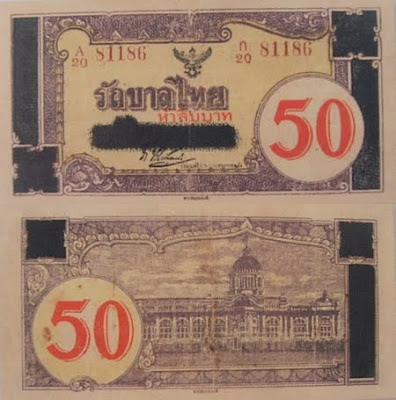
The Thai government printed new 1 Dollar banknotes for use in these 4 Malay states. But since the Japanese had already issued their own Dollar and Cents banknotes in all of occupied Malaya, Thailand decided not to launch these notes. Later in 1945 these notes were changed to 50 Baht when Thailand faced a shortage of banknotes. They were withdrawn and were not accepted as legal tender from Dec 1946.

These banknotes are often referred to as the "Mourning" notes as they were overprinted with black bands. They are now extremely difficult to find in any condition.

1 Dollar Pick R1
Pick R1: 1 Dollar - never issued

Pick 62Ba : 50 Baht overprint issued 8th Feb 1945

Pick 62Bc : 50 Baht overprint issued 13th Feb 1945

Pick 62Bb : 50 Baht overprint issued 21st Feb 1945

All above images courtesy of www.siambanknotes.com.